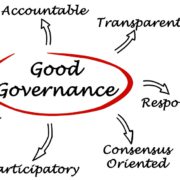
Governance is the Real Integrity Play
PwC’s latest Global Sports Survey signals a shift: integrity is no longer just the right thing to do — it’s a commercial and reputational imperative. Sheena Horgan explores what that means for sporting bodies.

PwC’s latest Global Sports Survey signals a shift: integrity is no longer just the right thing to do — it’s a commercial and reputational imperative. Sheena Horgan explores what that means for sporting bodies.
Read about how the nonprofit sector can build strategic capacity when it’s structurally designed to operate transactionally.

With the Government set to develop a successor to its current strategy for the sector, it’s timely to identify a few core objectives for inclusion.

Effective governance is not just a box-ticking exercise. It is the foundation for trust and, critically, for funding, which ultimately supports long-term success.

The Annual Report is the perfect medium to showcase your strategy & operations. When done right can be a crucial & high-impact communication tool.

The Charity Regulator’s new Strategy 2025–2027 sets out a vision for a “thriving, trusted charity sector in Ireland”. Shaped by the Charities (Amendment) Act and sector-wide consultation the Strategy signals significant changes in governance, reporting, and stakeholder engagement.

Key lessons that National Governing Bodies (NGBs) can take from the events surrounding the Camogie shorts versus skorts debate, highlighting the importance of listening, transparency, and adaptability.

Written by Sheena Horgan, Director of Advisory Services, 2into3.
There is a certain pragmatic logic in the phrase, don’t let the perfect bully the good, but can this be applied to governance? Especially when the organisation in question is non-profit.
However, socially good the credentials of a charity or organisation, they are no excuse for poor governance. That said, the nature of the sector does require it to balance best practice deliverables, with what is feasible given an organisation’s capacity and resources. Focusing on achieving functional and effective governance, as opposed to striving for perfection, can ensure accountability, transparency, and inclusivity while being adaptable to contextual challenges.
Good governance in the sector, is less about idealistic behaviour, and more about best practice. It should be realistic, first off recognising resource and capacity constraints, and then planning to address these in a coherent and incremental way that prioritises the most detrimental deficits.
Whilst it’s fair to say that not all governance gaps need to be tackled immediately, it is beholden on Boards to scope, articulate and navigate their organisation’s governance pathway. This likely means breaking down the complex governance agenda into manageable and context-sensitive steps. There will inevitably be trade-offs on what can be achieved now and what might be deferred. Asking the key question, ‘what will this governance task achieve?’, in relation to the organisation’s vision and mission and values, can be a helpful lens when considering which aspects are tackled first.
A cautionary warning though, agreeing what good or good enough governance entails, may be influenced by the Board’s entrenched views, group think and biases, and even ‘founder syndrome’. There is a reason why independent external Board Reviews are recommended on a regular basis within the Governance Code. Charities that rely only on internally conducted reviews, run the danger of reenforcing and perpetuating poor governance practices. Over the years, I’ve witnessed light-touch evaluations with little depth or robustness to be a genuine assessment. And I’ve seen how “governance” vocally weaponised in the Boardroom to sustain certain positions and viewpoints.
There is an abundance of case studies on poor governance and therefore no excuse for it to be brushed over. But to offer some guidance that might lessen the fear or enormity of “Good Governance” for charities and non-profits, here’s some simple principles of Good Enough Governance:
Governance structures should enable good decision making, so they need to be effective in practice rather than in theory. Consider policies and processes in this light, asking are they readable, accessible and implementable
Clarify the scope of what’s needed and design a time-line and pathway that allows for continuous progress and iterative governance capacity-building
Governance procedures should reflect, state and deliver their desired outcome e.g., integrity, accountability, etc.
New and revised governance practices are emerging all the time – take hybrid meetings, DEI and AI as cases in point. Taking an agile approach and adapting where required means having governance on Boards’ radar as well as agenda.
If you’re seeking governance support, visit our webpage for more information, or contact Sheena Horgan, Director of Advisory Services at sheena.horgan@2into3.com.

Trump 2.0 has sent shock waves throughout ESG circles and many commentators are suggesting that ESG’s time may be up. Such comments are short-sighted and overlook the depth of the corporate journey of ESG and therefore its resilience in the face of its critics.
Whilst ESG may be talked about as a trend that has found its way onto the agenda, its origins are more deep-rooted than that. Recessions, social unrest, inequality, all contributed to the impetus that saw Corporate Social Responsibility – the buzz term of the 90’s – evolve into today’s more formal corporate and ethical construct, ESG.
As a concept, ESG is not new. Its provenance and progress has arguably been public-driven, rooted in consumer and societal demand to do things differently, better. Increasingly since the turn of the century, shareholders have had to acquiesce to stakeholder activism as the demand for more responsible, accountable business practice took hold.
Park the acronym and examine the principles and what we’re talking about is accountability, transparency and equity. Double Materiality[i] is a critical, not hygiene factor these days. It makes sense that a well-run organisation would take a holistic view of itself examining both the ‘outside in’ and ‘inside out’ perspectives i.e. its impact on the society and environment in which it operates, and the society and environment in which it operates impact on the organisation. Success requires an appreciation of this symbiosis.
Protagonists may argue that without regulation, ESG will falter, but this sidelines the very real ‘carrot’ impetus for ESG – the benefits of deploying equitable labour practices, currying favour with your communities, being efficient with resources, systemising your decisions. The list is long, and having metrics for these, as required under CSRD, furthers the benefits because what you measure matters[ii]. It provides evidence of effect. It improves decision making and it allows organisations to benchmark and therefore to aspire and to improve. All of which deliver two critical organisational asks, reduce risk and enhance investment, so the financially faint-hearted needn’t fear ESG.
Good governance is about making good choices and decisions. Doing so requires good information, insight and an ability to look to the horizon and anticipate what’s coming. Of course, regulation has a serious part to play in this, but do not underestimate the power of people too. There is a reason why many US-based corporates are ‘hushing’[iii] their ESG work, continuing their commitment to the principles and practices but not shouting about it in an unreceptive business environment. The point that ESG somehow hinders economic growth is unsubstantiated and when you consider that the 2017-2020 Global ESG Assets grew substantially[iv], the opposite is more likely to be true.
The bottom line here is the triple bottom line[v]. I’ve advocated that doing good is good for business since the 90s and there is endless amount of research and data to support this truism. But the importance of delivering positive social impact has never been so great as it is now and it is incumbent on all constituents of society – charity, community, voluntary, public, private – to continue our commitment and support of ESG in principle and practice, if not in name.
Written by Sheena Horgan, Director of Advisory Services, 2into3.
If you would like to discuss your organisation’s ESG, social impact or governance needs, visit our webpage here or contact Sheena Horgan, Director Advisory Services at sheena.horgan@2into3.com.
Footnotes
[i] Double Materiality Guidelines
[iii] Guest Post – When Companies Go Quiet: Exploring the rise of Greenhushing – ESG Today
[iv] The Future of ESG: Under the Trump Administration – Michigan Journal of Economics

Anyone involved in leading or managing a charity or nonprofit dreads having to deal with a crisis under their watch. Despite adequate planning, we understand that even the best-prepared organisations can face unexpected crises. Whatever the focus of the crisis – funding, financial mismanagement, governance, safeguarding or reputational – here are 4 key words to help you keep a cool head at a stressful time.
The best way to manage a crisis is to prevent one occurring in the first place. This is what your organisation’s risk management and oversight practices are in place for: to identify potential risks at all levels of your organisation and putting in place effective mitigation or management structures, policies and practices.
Crisis management involves quick decision-making and action. Consider establishing a small team of leaders to develop and implement a crisis management plan. Make sure that their remit, responsibilities and reporting relationship to your Board is clear from the outset.
Key to your management of any crisis – and maintaining or re-building trust – will be how you communicate and engage your stakeholders. Develop a stakeholder map and communications plan that covers all your key relationships, particularly employees, volunteers, supporters and funders.
The best way to resolve any crisis is to ensure that there is appropriate action. It’s not advisable to shy away from acknowledging and investigating the incident, how and why it happened and its impact – and demonstrate accountability by identifying the clear steps that will be taken to redress its impact and prevent it from occurring again.
By prioritising anticipation, leadership, communication, and accountability, you will be in a better position to navigate any crisis that may arise. Remember, a well-prepared organisation is less likely to be caught off guard.
If you require additional support with your crisis management, 2into3 is experienced at supporting organisations to prevent anticipated crises and manage actual crises. Our governance and strategy services can help you to identify and mitigate organisational risks. Or, if the worst should happen, we can support you to effectively navigate through a crisis. In the last year, we have worked with six charities of different sizes to handle a range of funding, financial mismanagement, governance and reputational crises.
For more information, visit our webpage or contact our Director of Advisory Services, Sheena Horgan at sheena.horgan@2into3.com.